--- Background ---
Playwright: Arthur Miller (1915-2005)

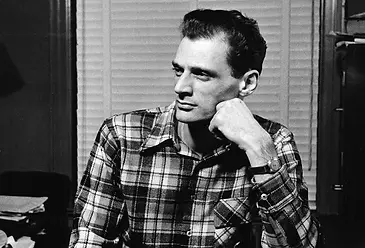
Top: Young Arthur Miller c. his college years
Bottom: Miller at his typewriter in 1949
Early Years
Arthur Asher Miller was born in Harlem on October 17, 1915, to Jewish immigrants Isidore and Augusta Miller. His father, born in what is now Poland, established himself as a respected and successful clothing manufacturer in Manhattan, affording the family a very comfortable lifestyle until the collapse of the business during the Great Depression. The subsequent financial hardship forced the family to relocate to Brooklyn, where Miller attended high school and worked a series of jobs to assist the household and save for college. This abrupt shift in social and economic circumstances profoundly shaped Miller’s artistic sensibilities; many of his plays explore the struggles of working-class families and the moral frameworks that sustain dignity in the face of adversity.
In 1934, Miller enrolled in the University of Michigan’s journalism program, where he wrote for various student publications and found his way to playwriting. Over the spring break one year, he stayed on campus and wrote his first play, No Villain. Of the change in medium, Miller recalled, "Why it had to be a play, rather than a story or novel, I’ve never been sure. But it was like the difference for an artist between a sculpture and a drawing — it seemed more tangible." He transferred to the English department and won the Avery Hopwood Award for No Villain in 1936 and for Honors at Dawn in 1937 (both one-acts).
Establishing Career
Miller’s professional debut came in 1944 with The Man Who Had All the Luck, a Broadway production that closed after only four performances. His fortunes shifted dramatically with All My Sons (1947), which garnered the New York Drama Critics’ Circle Award and A Tony Award for Best Author, establishing him as a major new voice in American theatre. Just two years later, Death of a Salesman (1949) premiered to overwhelming acclaim, securing the Pulitzer Prize for Drama, the Tony Award for Best Play, a Theatre World Award, and the Critics’ Circle Award, while simultaneously becoming a defining work of postwar American drama.
The following decade further demonstrated Miller’s commitment to dramatizing the ethical and political crises of mid-century America. The Crucible (1953) transposed the Salem witch trials into a searing allegory for McCarthy-era anti-communist investigations (see next section), earning multiple Tony Awards and inciting considerable public debate. It was in the following years that A View from the Bridge began its journey from an overly ambitious one-act to becoming another quintessential Miller piece that captured the struggle of the American Dream. These years crystallized Miller’s identity not only as a playwright of extraordinary achievement but also as a public intellectual who consistently aligned his art with urgent questions of morality, justice, and civic responsibility.
McCarthyism Entanglement: "Because it is my name!"
Involvement with the political upheaval of Senator Joseph McCarthy's accusatory rampage shaped both Miller's personal ethos and dramatic vision. As a prominent intellectual during the Red Scare, Miller was directly impacted by the House Un-American Activities Committee’s (HUAC) investigations into alleged communist sympathizers. While A View from the Bridge was finding success in its newly expanded version for the West End run in 1956, Miller was subpoenaed and ultimately convicted the following year of contempt of Congress for refusing to name others involved in leftist causes. He later explained that the refusal was not born of defiance alone: "I could not use the name of another person and bring trouble on him. I take the responsibility for everything I have ever done — but I cannot take responsibility for another human being." This reverence of one’s name and reputation, this insistence on personal honor in the face of public scrutiny, echoes in the internal conflicts of many of his characters.

Miller preparing to testify at a HUAC hearing on June 21, 1956
The idea of a man’s name as a symbol of his integrity is famously explored in The Crucible (1953). Protagonist John Proctor chooses death rather than to falsely confess and thereby tarnish his name, as he proclaims in Act IV: "Because it is my name! Because I cannot have another in my life! ... How may I live without my name?" Scholars have widely recognized the parallel between Proctor and Miller himself. Biographer Christopher Bigsby noted that "Miller’s refusal to cooperate with HUAC is mirrored in Proctor’s refusal to damn others to save himself." This act of resistance against institutional coercion positioned both Miller and his characters as figures whose moral sense of justice often clashed with written law.
Miller’s concern with name and reputation recurs in A View from the Bridge, where Eddie Carbone’s descent is partially driven by a need to maintain public image and familial authority. This work, too, reflects Miller’s enduring exploration of the self in society. As Susan C. W. Abbotson observed, "Miller's characters often struggle with societal pressures that threaten to strip them of the integrity bound up in their good names." In dramatizing such struggles, Miller positioned his art as a medium for ethical reflection on identity, public responsibility, and resistance.
Marriage & Children
Miller’s family life was marked by both conventional domesticity and extraordinary public scrutiny. In 1940, he married his college sweetheart, Mary Slattery, with whom he had two children: Jane (b. 1944) and Robert (b. 1947). Yet, as Miller’s stature as a dramatist grew, so did discord in the marriage. Miller later admitted that by the opening night of Death of a Salesman, he felt he had "outgrown" his wife, acknowledging a widening emotional distance between them despite their remaining together for several more years. Their divorce was finalized in June 1956, and Miller married actress Marilyn Monroe later the same month.
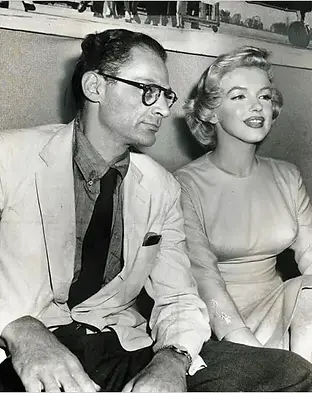
Newlyweds Miller and Monroe in July 1956
The high-profile marriage intertwined creative collaboration with personal turbulence. Miller wrote the screenplay for The Misfits (1961), Monroe’s final completed film, expressly for her, though the production’s difficulties mirrored the fragility of their relationship. They were further strained by three miscarriages in as many years, which contributed to the dissolution of the marriage in early 1961. Monroe died the following year, knowing that Miller and his new wife were expecting a child. The impact of their relationship reverberated through his later work: After the Fall (1964) offered a presumed autobiographical meditation on their undoing, while his final play, Finishing the Picture (2004), revisited the fraught making of The Misfits.
Not one for the bachelor life, Miller married Austrian photographer Inge Morath in 1962, with whom he shared both a creative partnership and a family life. Their daughter Rebecca, born the same year, later became a filmmaker whose documentary, Arthur Miller: Writer (2017), drew upon interviews, home movies, and Miller’s own narration to provide an intimate portrait of her father. In 1966, Miller’s fourth child Daniel was born with Down syndrome. Miller, who made the controversial decision to institutionalize him at birth, rarely spoke about their son in public, though Morath maintained a relationship with Daniel. The marriage was a happy one and endured until Morath’s death from lymphoma in 2002. That same year, Miller began a relationship with artist Agnes Barley, 53 years his junior, who lived with him during his final years.
"Dimmer or louder, yeah. I think there’s one thing to be said about [my characters]: they’re unmistakably mine… I didn’t work under such a cover of anonymity that my spirit is not in them."
- Arthur Miller, 1986 interview with Mel Gussow
Later Life and Death
Miller remained a central figure in both theatre and public life. Between 1968 and 1971, he served as president of International PEN, advocating forcefully for writers’ rights and free expression on a global scale. In the ensuing decades, Miller continued to produce new plays, including The American Clock (1980), a sweeping meditation on the Great Depression, and Resurrection Blues (2002), a satire on authoritarianism and media spectacle. His later work often returned to themes of moral responsibility, memory, and betrayal, culminating in Finishing the Picture (2004), which was completed in his late eighties.
Arthur Miller died at his home in Roxbury, Connecticut, on February 10, 2005, at the age of 89. His death occurred on the fifty-sixth anniversary of Death of a Salesman’s Broadway premiere, symbolically linking the end of his life with the play that had defined his career. Miller’s legacy lies in his redefinition of modern tragedy, bringing the struggles of ordinary people into dialogue with broader social and moral crises. His refusal to cooperate with HUAC and his leadership of International PEN established his role as a defender of intellectual freedom. His plays continue to be revived worldwide, resonating in times of political and social unrest, ensuring his place as one of the foremost voices of twentieth-century drama. He is buried next to his third wife, Inge, near their home in Roxbury. For all of the accolades and prestige he accumulated, his epitaph is simple: "Arthur Miller — Writer."

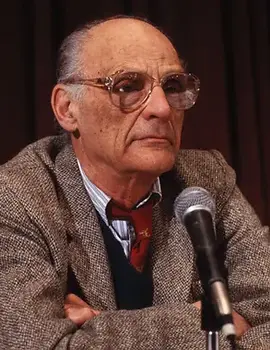
Miller c. 1986
Miller's grave in Roxbury, Copnnecticut
Legacy of Theatre Works
Produced Plays
-
The Man Who Had All the Luck (1944)
-
All My Sons (1947)
-
Death of a Salesman (1949)
-
The Crucible (1953)
-
A View from the Bridge (1955, one-act; revised into two acts in 1956)
-
After the Fall (1964)
-
Incident at Vichy (1964)
-
The Price (1968)
-
The Creation of the World and Other Business (1972)
-
The Archbishop’s Ceiling (1977)
-
The American Clock (1980)
-
Playing for Time (1980, TV play; staged later)
-
The Ride Down Mt. Morgan (1991; premiered in London, U.S. in 1998)
-
The Last Yankee (1993, full-length version developed from earlier one-act)
-
Broken Glass (1994)
-
Mr. Peters’ Connections (1998)
-
Resurrection Blues (2002, first staged posthumously in 2006)
-
Finishing the Picture (2004)
Notable One-Acts
-
No Villain (1936, Miller’s first play, rediscovered and staged in 2015)
-
They Too Arise (1937; an early version of No Villain)
-
Honors at Dawn (1938)
-
The Grass Still Grows (1938, lost)
-
The Great Disobedience (1938)
-
Listen My Children (1939)
-
That They May Win (1940)
-
The Golden Years (1940, unproduced until 1987)
-
The Half-Bridge (1943, lost)
-
Elegy for a Lady (1982, paired with Some Kind of Love Story as Two-Way Mirror)
-
Some Kind of Love Story (1982, with Elegy for a Lady)
-
I Can’t Remember Anything (1987, paired with Clara as Danger: Memory!)
-
Clara (1987, paired with I Can’t Remember Anything)