--- Background ---
Origins of the Story
In 1947, Miller wrote an unproduced screenplay entitled The Hook, which recounted the true story of Pete Panto (fictionalized as Marty Ferrara), an Italian-American longshoreman and union activist who challenged the mafia-controlled union leadership and was subsequently murdered. Although this early project was never realized during Miller’s lifetime, it marked the beginning of his enduring interest in depicting the working-class culture of Brooklyn’s waterfront. Reflecting on the area, Miller observed, “Well, this particular area of Red Hook and the waterfront stands right under Brooklyn Bridge, and Brooklyn Bridge, it always struck me, oddly, that here’s this commuter traffic going over it night and day; people going out to nice neighborhoods, somewhere else passing over this area where this Greek drama was taking place, and nobody ever thought about it... the different culture that was down there was unknown to the people on the bridge, so it was a view from our culture … down into their culture.”
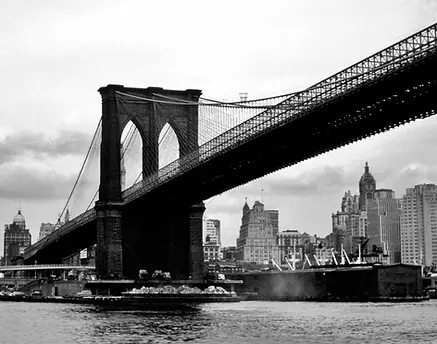
Shipping activity beneath Brooklyn Bridge, New York City
In his autobiography, Miller recounts a story shared by his lawyer friend, Vinny Longhi, about a longshoreman who informed on his own relatives (two brothers living illegally in his home) to the Immigration Bureau. The informant's motive was to prevent the marriage of his niece to one of them, but this act of betrayal led to the informant's social ostracization and, according to local gossip, his eventual murder by one of the brothers. Miller was deeply moved by the tale, again likening it to a Greek tragedy and seeing in it a profound sense of fate. This story, combined with his experiences on the Brooklyn waterfront during his time working with Longhi and union organizer Mitch Berenson, deeply influenced the development of A View from the Bridge.
Evolution of the Text
Original Form
The first incarnation of A View from the Bridge debuted on Broadway in 1955, presented as a one-act verse drama alongside another Miller one-act, A Memory of Two Mondays. Harkening back to Greek antecedents more than adhering to contemporary realism, the form employed a narrator-chorus role and the characters spoke largely in verse for dramatic effect. Miller himself described the script as "an experiment. I wanted to see whether I could write a play with one single arc instead of three acts … I wanted to have one long line with one explosion. Which is rather the Greek way we’ve all forgotten … it was simpler and more direct."
Critics, however, found this austerity and formal abstraction unsatisfying. Brooks Atkinson, writing in The New York Times, judged it "a curious hybrid" and noted that Miller’s verse seemed "stilted" compared to his earlier naturalism. Despite a respectable run, the production was generally considered a mild failure that left audiences uneasy with its stylized, mythic approach.
Subsequent Revision
In response to this lukewarm reception, Miller reshaped the piece into a full-length, two-act prose play, which premiered in London the following year. The revision dispensed with verse, expanded the roles of Beatrice and Catherine, and enriched the psychological realism of the drama. By shifting from the ritualized cadence of verse to naturalistic dialogue, Miller sought to restore the empathic resonance and social breadth of the play, enabling the audience to connect more fully with Eddie’s downfall. Scholars have argued that the 1955 version, while ambitious, was trapped between the symbolic aspirations of Greek tragedy and the emotional realism of modern drama, whereas the two-act prose revision found a balance between mythic framing and psychological depth. This second iteration is the version most frequently studied, produced, and recognized as a modern American classic, as well as one of Miller’s most celebrated plays.
ALFIERI:
Most of the time now we settle for half,
And I like it better.
And yet, when the tide is right
And the green smell of the sea
Floats in through my window,
The waves of this bay
Are the waves against Siracusa,
And I see a face that suddenly seems carved;
The eyes look like tunnels
Leading back towards some ancestral beach
Where all of us once lived.
And I wonder at those times
How much of all of us
Really lives there yet,
And when we will truly have moved on,
On and away from that dark place,
That world that has fallen to stones?
This is the end of the story. Good night.
ALFIERI:
Most of the time now we settle for half and I like it better. But the truth is holy, and even as I know how wrong he was, and his death useless, I tremble, for I confess that something
perversely pure calls to me from his memory – not purely good, but himself purely, for he allowed himself to be wholly known and for that I think I will love him more than all my
sensible clients. And yet, it is better to settle for half, it must be! And so I mourn him – I admit it – with a certain . . . alarm.
Alfieri's closing lines from Miller's original script written in verse (left) next to the same moment in the full-length prose version (right)
Verse or Prose: What's the Difference?
In simple terms, verse is structured language, like that often found in poetry and song lyrics. It is characterized by rhythm, rhyme, and meter. It can sound formal and heightened. A well-known example of a play written in verse is Romeo and Juliet by William Shakespeare. It is important to note, however, that free verse does not necessarily rhyme, but does maintain a sense of lyricism and formality. Miller's original one-act employed free verse most often.
Prose is a more common, everyday form of writing, found in novels, articles, essays, and the majority of contemporary plays. It follows standard grammatical structure without a specific metrical pattern. It sounds conversational and realistic.
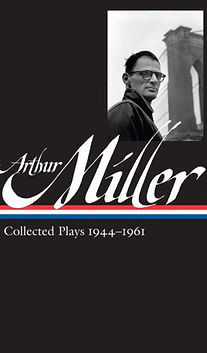
One of the only accessible copies of the original one-act playscript can be found in Arthur Miller: Collected Plays Vol. 1 1944-1961 (LOA #163)
Relationship to Greek Tragedy
The Form at the Heart of Modern Drama
The roots of Greek tragedy lie in dithyrambs (choral hymns sung in honor of the god Dionysus), which were eventually adapted into dramatic performance by figures like Thespis, who is traditionally credited with introducing the first actor separate from the chorus. By the 5th century BCE, the great tragedians Aeschylus, Sophocles, and Euripides were writing in a solidified genre with distinct structure and themes, serving as both a medium for public reflection and as a competitive art form judged by Athenian citizens. Staged during public festivals, tragedies addressed the moral, political, and existential questions facing the city-state.
Although the plays were deeply embedded in their historical context, they have continued to shape Western aesthetic and philosophical traditions through their exploration of human suffering, divine justice, and the limits of reason.

The great theater of Epidaurus, one of the amphitheaters of Ancient Greek performance (constructed 4th century BCE)
Structure and Features
Greek tragedies generally followed a consistent dramatic structure:
-
A play opened with a prologos (spoken exposition),
-
followed by the parodos (choral entrance; often foreshadowed themes and events).
-
The narrative progressed through alternating epeisodia (singular epeisodion; spoken scenes where the main action played out)
-
and stasima (singular stasimon; choral commentary or reflections).
-
Finally, it concluded with an exodos (plot resolution; last choral musing and departure).
This rhythmic alternation between speech and song mirrored the balance between action and reflection — a tension at the heart of the tragic experience.
Another structural feature was the agon, a formal debate scene between two characters representing conflicting values or beliefs. While Miller does not directly utilize the agon, a similar battle of ideologies is reflected in Eddie’s recurrent conversations with Alfieri about law versus justice and the ongoing clash between the different interpretations of masculinity that Eddie and Rodolpho exemplify.
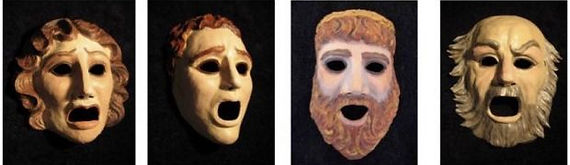
“Greek” masks (as none survive) by Tessa Wallis chosen by the Classics Theatre, Rochester, New York for its promotion of The Theban Plays of Sophocles.
The Tragic Hero
At the center of most tragedies stands a tragic hero, typically a figure of noble birth who suffers a fall due to a combination of hamartia (flawed judgment or behavior), hubris (excessive pride), and fate. The hero’s fall is not entirely deserved, but it is inevitable.
Miller’s Eddie is certainly not of high birth, but he is of good standing in his community; his name and reputation are of worth in Red Hook. But enter his hamartia, his flaw: An obsessive, possessive love for his niece and a need to assert masculine control blind him to reason and alienate his family and community.
Eddie has plenty of hubris for a Greek tragedy, too. His pride and sense of honor, especially around masculinity, family reputation, and control of his household, cause him to reject compromise. His refusal to accept Catherine’s relationship with Rodolpho, and ultimately his betrayal of Marco and Rodolpho to Immigration, stem from his unwillingness to be seen as weak or dishonored.
The Chorus
In Ancient Greece, the chorus was a collective character, usually played by 12 to 15 men, who sang and danced in unison, serving as a moral and emotional compass for the audience. The chorus provided context, posed philosophical questions, and responded to the dramatic action. Simon Goldhill emphasizes that the chorus was "not marginal but central to the ideological and aesthetic structure of tragedy." Miller renders a modern chorus in A View from the Bridge through the narrator, Alfieri.
Traditionally, both chorus members and character actors wore masks for a variety of practical reasons (enabling role doubling, amplifying facial expressions, and enhancing vocal resonance in vast open-air theaters), but more symbolically, they allowed performers to transcend individuality and become archetypes or collective voices. Edith Hall frames the masks as a device that moved the actors from the confines of their personal identities into a "ritualized, mythic space."