---- Production History ----
1955: Premiere on Broadway
Arthur Miller’s A View from the Bridge first appeared on Broadway on September 29, 1955, as a one-act verse drama, presented in tandem with his companion piece, A Memory of Two Mondays. The double bill, directed by Martin Ritt and staged at the Coronet Theatre (now the Eugene O’Neill Theatre), featured Van Heflin as Eddie Carbone and employed much of the same cast across both works. In keeping with Miller’s avowed ambition to model the play on Greek tragedy, the text relied on a single arching dramatic line and the choral presence of Alfieri. The production’s visual world, realized by scenic designer Boris Aronson, reinforced this tragic ambition through an Expressionist aesthetic that critics noted for its brooding and sculptural atmosphere.
Despite its visual sophistication, critical response to the play itself was mixed. Brooks Atkinson of The New York Times deemed the acting “taut and brittle” and argued the script’s lack of psychological fullness, suggesting that the characters required more “flesh” and context beyond the immigrant brothers, Marco and Rodolpho (Richard Davalos earned a Theatre World Award for his portrayal of Rodolpho). This perception of underdevelopment contributed to the play’s mediocre success, though elements of its dramatic tension and symbolic weight were acknowledged. The design work nonetheless received significant recognition, with Tony Award nominations for Aronson and costumer Helene Pons. After nearly 150 performances, the play closed on February 4, 1956. Responding to the critical consensus, Miller substantially revised the play, expanding it into a two-act prose version that premiered later in 1956 in the West End (London).
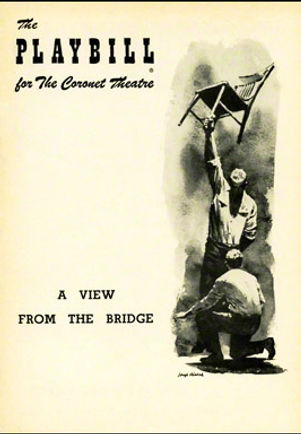
Original Playbill cover from the 1955 premiere

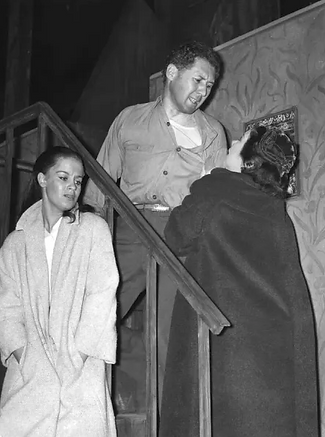
Gloria Marlowe as Catherine, Van Heflin as Eddie, and Eileen Heckart as Beatrice
Principal Cast
David Clarke (Louis), Tom Pedi (Mike), J. Carrol Naish (Alfieri), Van Heflin (Eddie), Gloria Marlowe (Catherine), Eileen Heckart (Beatrice), Jack Warden (Marco), Antony Vorno (Tony), Richard Davalos (Rodolpho), Curt Conway (First Immigration Officer), Ralph Bell (Second Immigration Officer), Russell Collins (Mr. Lipari), Ann Driscoll (Mrs. Lipari), Leo Penn (“Submarine”), Milton Carney (“Submarine”)
Design, Production & Staff
Martin Ritt (Director), Boris Aronson (Scenic), Helene Pons (Costume), Leland "Lee" Watson (Lighting), Harrv Young (Stage Manager)
1956: Expanded Version in the West End
After Miller's substantial script revisions, the new two-act prose version opened on October 11, 1956, in London under Peter Brook's direction and design. Because homosexual acts were criminalized in the United Kingdom at the time, the Lord Chamberlain’s Office denied the play a performance license. To circumvent state censorship, the producers converted the Comedy Theatre (now the Harold Pinter Theatre) into a private club, allowing the play to be presented in its entirety. A View from the Bridge was the inaugural production of The New Watergate Theatre Club, leading a season devoted to censored (and popular) American works.
Opening night was somewhat overrun by the attendance of Miller’s new wife, Marilyn Monroe. Fans and press alike clamored to catch a glimpse of the American starlet as she arrived at the theater. Though media coverage of the premiere focused greatly on Monroe, she insisted that she was “just Mrs. Miller tonight.”
Despite the brief celebrity distraction of Monroe, the production was celebrated by critics. Anthony Quayle’s performance as Eddie was praised consistently for its depiction of a frustrated and inarticulate struggle towards self-knowledge, and renowned critic Kenneth Tynan deemed the play “just short of a masterpiece.” Miller, worried about “bloodlessly polite” British delivery of the working-class Italian-American lines, and Brook had actively sought street authenticity in casting. The result was praised as “uncannily good,” with Quayle’s Eddie singled out for “stumbling, inarticulate passion and envy.”
One of the most lauded elements of the production was Brook’s set design. He had employed a notoriously sparse and minimalistic set, intended to lean into the intensity of the drama rather than rely on ornate spectacle like more traditional designs.

Top: Anthony Quayle, Arthur Miller, Mary Ure, and director Peter Brook table-working the expanded script
Bottom: Mary Ure as Catherine, Anthony Quayle as Eddie, and Megs Jenkins as Beatrice in rehearsal
Without much by way of clutter and décor, the stark, sharp lighting played a prominent part in creating the heightened emotional atmosphere in key moments. The set featured a dominant bridge motif, looming over the action “like a huge nutcracker waiting to crush them,” according to Milton Shulman of the London Evening Standard. Together, these elements underscored Miller’s Greek-tragic frame and fatalism while also rendering the tense, repressed energy of the Carbone home. The Times of London dressed down the need for the chorus-like Alfieri and questioned the worthiness of a common domestic drama to be given the structure of a high Greek tragedy, but still complimented the acting and Brook’s scenery as “sombre, ingenious, and serviceable.”
The production closed on April 20, 1957, with no documented awards or nominations despite strong critical acclaim.
Principal Cast
Richard Harris (Louis), Norman Mitchell (Mike), Michael Gwynn (Alfieri), Anthony Quayle (Eddie), Mary Ure (Catherine), Megs Jenkins (Beatrice), Ian Bannen (Marco), Ralph Nossek (Tony), Brian Bedford (Rodolpho), John Stone (First Immigration Officer), Colin Rix (Second Immigration Officer), Mervyn Blake (Mr. Lipari), Catherine Willmer (Mrs. Lipari), Peter James (A “Submarine”)
Design, Production & Staff
Peter Brook (Director, Scenic, Costume, and Lighting), Michael Northen (Assistant to the Designer), Alick Johnstone (Scenery Painter), Lily Taylor (Chief Costume Supervisor), Joe Davis (Lighting Supervisor), Judith Spearman (Stage Manager)

Newly married Marilyn Monroe and Arthur Miller arrive at the London premiere

Procedure per the official program for becoming a club member and securing a ticket
1965: First Revival (Off-Broadway)
Directed by Ulu Grosbard and assistant-directed by Dustin Hoffman, this first American production with the new script was staged at the Sheridan Square Playhouse, a relatively recent build that housed an intimate performance space. Its 780-performance run marked it as a significant Off-Broadway revival, bringing Miller’s play back into the theatrical conversation mid-century.
1983: Broadway Revivals Begin
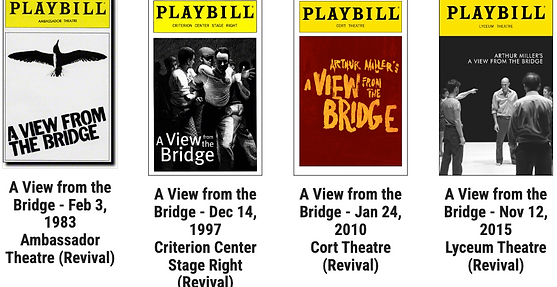
Beginning in the 1980s, Broadway produced a revival nearly every decade.
1983: Directed by Arvin Brown; nominated for two Tony Awards and Alan Feinstein's Marco received a Drama Desk Award
1997: Directed by Michael Mayer; received Tony Awards for Best Revival and Best Actor for Anthony LaPaglia's Eddie; featured Allison Janney as Beatrice
2010: Directed by Gregory Mosher; Scarlett Johansson received the Tony Award for Best Featured Actress as Catherine; featured Liev Schreiber as Eddie
2015: (See 2014 London production below; transferred to Broadway in 2015)
1987: Landmark Production at the National Theatre, London
Originally staged at the Cottesloe Theatre and eventually transferred to the Aldwych Theatre in the West End, Miller was initially somewhat surprised by the interpretation (particularly the humor), but reportedly hailed Michael Gambon’s performance as “the best Eddie, ever!” This staging is considered a definitive production, finally approaching that elusive balance between classical tragic structure and modern domestic drama.
With Alan Ayckbourn directing, the production opened in February of 1987 and ran for a full year, including the Aldwych transfer. London critics universally praised Ayckbourn’s meticulous and detailed naturalism against Alan Tagg’s two-level minimalist set design, which was not common for the time.
A View from the Bridge was among the four plays Gambon agreed to develop with Ayckbourn’s company during the director’s 1986–1988 residency at the National Theatre. Staging the production in the intimate 300-seat Cottesloe Theatre required working with the smallest budget of the four projects, but also allowed for the flexibility of off-site rehearsals. Ayckbourn’s critical approach to the play marked a departure from all previous interpretations, earning the production an unprecedented level of acclaim.
Ayckbourn directed the work with an accelerated tempo, which critic Irving Wardle described as the cast “chipping into each other’s lines.” This heightened pace shortened the performance by nearly an hour, while simultaneously infusing the piece with fresh energy. In addition, Ayckbourn encouraged the company to uncover and highlight the latent humor within Miller’s script. Drawing on his own experience with tragedy and dark drama, he believed that moments of levity and warmth would render the eventual downfall more affecting. Another significant innovation was his decision to introduce the Red Hook community characters earlier than Miller had written, thereby foregrounding the neighborhood’s presence and reinforcing Eddie’s position within it. Together with Gambon’s commanding portrayal of Eddie, these directorial choices established Ayckbourn’s production as one of his most consequential projects and solidified his reputation as a director of remarkable interpretive insight.
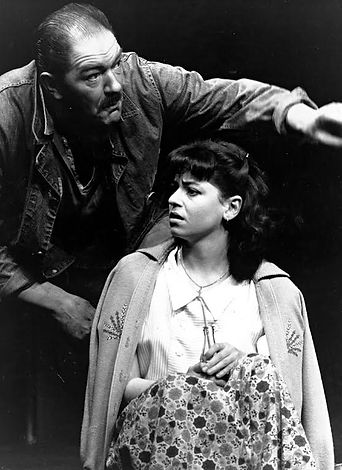
Michael Gambon as Eddie and Suzan Sylvester as Catherine

Michael Gambon as Eddie

Adrian Rawlins as Rodolpho and Michael Gambon as Eddie
Central to the production’s success was Michael Gambon’s commanding portrayal of Eddie Carbone, which critics across London hailed as monumental. His performance combined physical power with psychological depth, rendering Eddie both imposing and tragically human, and in doing so, finally realized Miller’s vision of the modern tragic hero. Irving Wardle observed that earlier interpretations of Eddie had been marked by an “invincible stupidity” that failed to elicit sympathy; Gambon, however, overturned this tradition, embodying the character as Alfieri describes him: “as good a man as he had to be.” Michael Billington of The Guardian emphasized the duality of Gambon’s presence, describing “sensitivity lurking inside a muscular frame,” and noting how this quality sharpened Eddie’s unhealthy fixation on Catherine, whether through violent gestures such as stabbing a fork into the table or through withering glares reminiscent of Laurence Olivier. Even after witnessing Ivo van Hove’s acclaimed 2015 reimagining at the National Theatre, Billington reaffirmed the superiority of the 1987 staging, remarking that Ayckbourn’s more naturalistic approach underscored the play’s dual identity as both a social and psychological tragedy. Amid the near-universal focus on Gambon, Adrian Rawlins’ Rodolpho drew critical notice, with his performance earning sufficient acclaim to propel him into the role of Marco in the Broadway revival a decade later, in 1997.
This production brought Miller’s play, which had been a source of embarrassment for his admirers, into the canon of serious British repertory theatre. Critics often cite this production as the one that elevated A View from the Bridge to the status of Miller’s finest tragedy alongside Death of a Salesman. It reframed the play not only as social realism but as a Greek-inflected tragedy, paving the way for later directors to push the symbolic and ritualistic dimensions even further.
Principal Cast (Cottesloe Theatre, London)
Russell Dixon (Louis), John Arthur (Mike), James Hayes (Alfieri), Michael Gambon (Eddie), Suzan Sylvester (Catherine), Elizabeth Bell (Beatrice), Michael Simkins (Marco), Paul Todd (Tony), Adrian Rawlins (Rodolpho), Allan Mitchell (First Immigration Officer), Paul Stewart (Second Immigration Officer), Nigel Bellairs (Mr. Lipari), Mary Chester (Mrs. Lipari), Kate Dyson (Submarine Woman)
Design, Production & Staff (Cottesloe Theatre, London)
Alan Ayckbourn (Director), Alan Tagg (Scenic) Mick Hughes (Lighting), Rob Barnard (Sound), Helen Fitzwilliam (Costume), Courtney Bryant (Stage Manager)
Principal Cast (Aldwych Theatre, West End transfer)
John Hartley (Louis), Richard Cordery (Mike), James Hayes (Alfieri), Michael Gambon (Eddie), Suzan Sylvester (Catherine), Elizabeth Bell (Beatrice), Michael Simkins (Marco), Paul Todd (Tony), Adrian Rawlins (Rodolpho), Peter Dineen (First Immigration Officer), David Michaels (Second Immigration Officer), Brian Vaughan (Mr. Lipari), Geraldine Wright (Mrs. Lipari), Andrew Jolly (Submarine), Mark Phillips (Submarine), Catherine Furshpan (Neighbour), Maggi-Anne Lowe (Neighbour)
Design, Production & Staff (Aldwych Theatre, West End transfer)
Alan Ayckbourn (Director), Alan Tagg (Scenic) Mick Hughes (Lighting), Rob Barnard (Sound), Lindy Hemming (Costume), Richard Mangan (Company Stage Manager)
2014: Ivo van Hove's Reinvention
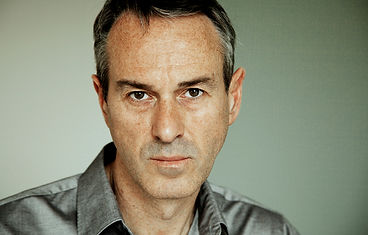
Ivo van Hove, director
Ivo van Hove’s staging of A View from the Bridge stands as one of the most transformative interpretations of Arthur Miller’s work. Invited to direct at the Young Vic by then-artistic director David Lan, this production marked van Hove’s first collaboration with British actors and his first Miller project. The Belgian director approached the play not as a slice of postwar realism but as an elemental tragedy, stripping away domestic detail to reveal the raw moral and emotional architecture beneath. Van Hove framed his vision in universal, political, and spiritual terms. Reflecting on the Broadway transfer and U.S. tour, he observed, “America has become more difficult to enter, which is a pity for the land of freedom. Which is a point Miller was making.” This remark situates the production squarely within the modern discourse on immigration, aligning Miller’s Brooklyn tragedy with global anxieties about borders and belonging.
Example of the color, staging, and sound from the National Theatre at Home recording
Van Hove and scenic designer Jan Versweyveld rejected the play’s conventional kitchen-sink setting, instead placing the actors within a bare, box-like space devoid of furniture or realistic markers. The performers were barefoot, dressed in modern clothes, and enclosed by stark white walls that created a visual field of ritual and exposure. The stage became an arena of physical confrontation, its long silences punctuated by Tom Gibbons’ drums and requiem tones, suggesting the inevitable rhythm of fate. The production’s climax — a blood-soaked melee achieved by a cascade of blood-red rain — stripped the story to its mythic essence, transforming the domestic conflict into sacrificial ritual. Critics recognized this stylization as a return to Greek tragic form, especially through Alfieri’s role of classical chorus. Van Hove, however, also gradually integrated Alfieri into the action. The effect was both archaic and immediate, collapsing time between the ancient and contemporary.
The visual and sonic austerity of van Hove’s production intensified the play’s ritual violence. The London Evening Standard praised the design’s “startling simplicity” and called the staging “bruising and revelatory,” noting how Gibbons’s sound design created a “forceful, potent impression of the characters being trapped” within the unseen boundaries of their moral codes and Catholic guilt. Variety characterized the result as “triple-distilled and served neat: 100 percent proof,” admiring how “every design element works to fine-tune our focus.” The same review likened the set to “an amphitheater, a church and a giant microscope,” an apt description of van Hove’s ability to fuse the sacred, the communal, and the analytical within one theatrical frame. In this stripped environment, Miller’s moral dilemmas became universal struggles between eros, honor, and law.
When the production transferred to Broadway, The New York Times hailed it as a “magnificent reconception,” arguing that Miller’s “exalted notion that classic tragedy and the common man can indeed coexist has never seemed so organic.” The review observed that van Hove’s integration of Alfieri blurred the line between witness and participant, suggesting that the tragedy existed not in the past but within a collective moral consciousness. The review’s description of the performance space as “that stark space in memory reserved for scenes so fraught that they have seared away all contextual detail” captures the production’s psychological intensity. What emerged was not a historical re-creation but a metaphysical meditation on guilt and desire, purified through van Hove’s minimalism.
Van Hove on Miller's playscript with rehearsal footage
Van Hove himself articulated his attraction to Miller in terms of scale and emotional release. “Miller was in touch with what a tragedy really needs, which is a really wonderful catharsis,” he told The Chicago Tribune’s Chris Jones. “He made everything bigger than the specific immigrant lives he was showing you on stage. He made everything emblematic.” This philosophy shaped every aspect of the staging, from its ritualized movement to its elemental use of sound and light. The production’s international trajectory — from its 2014 premiere at the National Theatre to the West End, Broadway, Los Angeles, Washington D.C., and Chicago — underscores both its artistic and cultural reach. Across continents, van Hove’s A View from the Bridge reaffirmed Miller’s capacity to speak to the moral anxieties of modernity while reasserting tragedy’s place at the center of contemporary theatre.

Minimalist staging and scenic design featuring the Young Vic cast

Nicola Walker (Beatrice), Emun Elliott (Marco), and Mark Strong (Eddie) in the final moment of Act I
Principal Cast (Young Vic, London)
Mark Strong (Eddie), Phoebe Fox (Catherine), Nicola Walker (Beatrice), Michael Gould (Alfieri), Richard Hansell (Louis), Padråig Lynch (Officer), Luke Norris (Rodolpho), Emun Elliott (Marco)
Design, Production & Staff (Young Vic, London)
Ivo van Hove (Director), Jan Versweyveld (Design and Light), Tom Gibbons (Sound), An D’Huys (Costume), Bart Van den Eynde (Dramaturg), Christopher C. Bretnall (Technical Producer)
Principal Cast (Lyceum Theatre, Broadway transfer)
Mark Strong (Eddie), Nicola Walker (Beatrice), Phoebe Fox (Catherine), Russell Tovey (Rodolpho), Michael Zegan (Marco), Michael Gould (Alfieri), Richard Hansell (Louis), Thomas Michael Hammond (Officer)
Design, Production & Staff (Lyceum Theatre, Broadway transfer)
Ivo van Hove (Director), Jan Versweyveld (Scenic and Lighting), Tom Gibbons (Sound), An D’Huys (Costume), Dean R. Greer (Stage Manager)
Other Notable UK Productions
1992: Directed by Greg Hersov at the Royal Exchange Theatre, Manchester
1992: Directed by Michael Napier-Brown at the Royal Theatre, Northampton
2009: West End revival directed by Lindsay Posner at the Duke of York’s Theatre, London
2023: Chichester Festival Theatre, West Sussex
2024: West End revival directed by Lindsay Posner at the Theatre Royal Bath and transfer to the Theatre Royal Haymarket, London